
Brendan explains putting a water channel along a contour line,
to distribute water evenly across the slope to 'irrigate' a new orchard.
Long is the Chinese word for dragon, and at Long Breath Farm on the slopes of the Waitakere Ranges in west Auckland the mists swirl in long wisps – the breath of the dragon. It is a good pun of a name as well, because seeing what Brendan and Li-Chen Hoare are creating on their property is enough to make one draw a long breath.
Brendan gave me a very quick tour of
the farm on the morning of May 13, before we went back to our
respective organic stalls (Biogro and the Soil and Health
Association/Organic NZ) at the Green Living Show. Long Breath Farm
is on a series of ancient gentle north-facing step-like slumps. The
land was covered in native forest for millenia, but sometime in the
twentieth century this was cut down and replaced by paddocks for
grazing and blocks of pine trees. Brendan and Li-Chen are trying to
reinstate the polyculture production system of East Asia, based on
forests and birds (and the odd pig). They are now engaged in a
conversion process which will see all the land return to forest –
some of it native, some of it producing fine timber, and some of it
producing a great variety of food in a sustainable way.
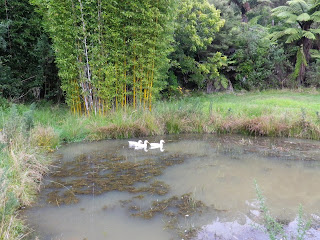

Ducks and fish in the pond, and a healthy stand of bamboo
The first step in the process has been to work with the abundant water resource below the land, channeling and directing it in ways which do the most good and the least harm. When he first studied horticulture Brendan was taught – first you drain the land, then you irrigate it. Both these activities require a lot of energy and expensive equipment, and both are completely unnecessary if a more intelligent and informed approach to working with water is adopted. Brendan has studied the methods of Asian farmers who have been successfully growing rice and other crops on slopes for centuries, without either draining or irrigating in the modern Western sense. He has adopted their techniques for spreading ground water out across the land, so that it both 'irrigates' everything grown there, and 'drains' away from places where it could pool and become a problem.
These techniques include channeling
water across appropriate contour lines, damming water at regular
intervals in creeks, making ponds that can also be put to
food-producing uses (fish, ducks, water vegetables), and using trees
to soak up water in potentially marshy spots. Native trees are good
in this last role, but they do not thrive if planted in the open. So
Brendan plants fast-growing exotic deciduous trees like poplars,
willows and alders (which can later be used for firewood or mulch) to
create a shady canopy for slower-growing natives like totara and
kahikatea.
This 'whole landscape' approach to
growing is so different from the industrial agriculture approach -
isolating a piece of land and beating it into the size, shape and
water content required for a mono-culture of a particular grain,
fruit or vegetable – that it can be hard to believe that Long
Breath Farm really is a farm producing a lot of food (and wood),
since it looks nothing like the rectangular and rather barren shapes
we associate with farms in New Zealand. Yet as I watched Brendan
gather tamarillos from under a well-laden tree I could see for myself
that taking a holistic approach works, and works well.


Brendan gathers abundant tamarillos
Visit Long Breath Farm
Brendan and Li-chen run tours, workshops
and training opportunities from Long Breath Farm. Contact Brendan on
09 8328986 or email on hoareb@gmail.com for more information.


Hi Christine. I'm just starting a PhD exploring food democratisation in NZ, specifically 'free' food outside of the monetary/corporate system, looking at people and communities involved in things like dumpster diving, community gardening, food foraging wwoofing, etc. I just bought your book Food@home because of it's relevance to this topic and thought you might be a good person to network with. Isa Ritchie
ReplyDeleteKia ora Isa,
Deleteyour research sounds very interesting and timely. I can put you in touch with people who can help and tell you about other academic research/researchers on the subject. Give me a call on 03 329 4588/send me your number and we can talk it over.
Christine
I just love this type of gardening, my company
ReplyDeleteonly gets to work in suburban areas instead of these beautiful eco farms.