Thursday, June 28, 2012

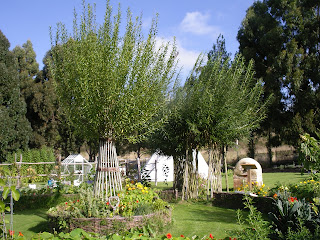
A fedge of living willow


The fedge between the potager and the ornamental garden at Riverstone Cafe

Now that all the deciduous trees are bare it is time to get out and plait your hedges, folks! Seriously, if you have the skills of basket maker Mike Lilian, of Kakanui, then you could indeed make very beautiful hedges (or fedges – cross between a fence and a hedge) of woven living willow.

I saw some of Mike's work on a trip south in March. At the Riverstone Cafe just south of the Waitaki River there is a long fedge dividing the potager from the ornamental garden, with a woven archway between the two. At the community garden in Oamaru there is a fedge, two archways, and and two living tepees which can be used as supports for annual climbing plants, like beans or sweet peas.
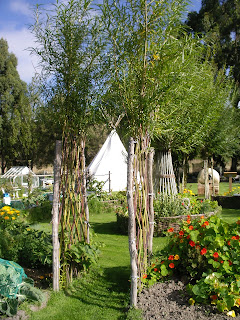
The fedge at the Oamaru Community Garden

An article in NZ House and Garden explains how the weaving is done. Mike plants the living willow rods in winter, and weaves them into the fedge pattern. In spring they sprout leaves at the top, and by summer they have a leafy green hedge layer around head height. In the following and subsequent winters they need tending to keep the pattern straight, remove unwanted shoots, and so on, so they are a bit of work – but then regular hedges are too, so why not have some fun with them?

 Woven willow tepee at the Oamaru Community Garden 

Looking through a woven archway to the 
Oamaru Community Garden (real) tepee

Wednesday, June 13, 2012

Aerobic gardening


My best aerobic exercise 'machines' - all sweat powered!

Among the many things I love about gardening is that it is hard work. Since I spend so much of the day sitting down doing research and writing it is a treat for me to get out in the garden and do something with my body that requires more effort. Enough effort to keep me reasonably fit and trim – and the beauty of getting one's exercise by gardening is that not only is the 'outdoor gym' right at one's back door, it also doesn't cost anything to belong to it and it saves you money on food. What's not to like about it?

But how does one know whether one is working hard enough in the garden to get fitness benefits? I do the heart rate test – checking the pulse on my right wrist while looking at my watch on my left wrist to see how many beats it is beating every 10 seconds. Then I multiply those beats by 6 to get beats per minute, and if that comes to between 110-130 per minute I know I am in the aerobic fitness zone, where my heart is pumping oxygen at 70-80% capacity. The numbers of beats in the aerobic fitness zone depends on one's age, gender and even the type of exercise one is doing. It is a bit more complicated than I thought it was when I first learned to count my pulse - which you can read about here and here – but I am not fussed about this as there are other indicators that one is in the zone, such as slightly faster or deeper breathing and a slight sweat, not to mention a definite feeling of exerting oneself.


It took me two hours to dig over the two small bare patches in the photo at right - in the process unearthing the rocks in the photo above. Getting them out with a crowbar was VERY aerobic.


Now obviously there are some gardening activities, such as dead-heading roses, potting up seedlings, and watering with a hand-held hose, that require very little effort at all. At the other extreme are mowing with a push mower (especially on a slope), grubbing rough ground, turning or spreading compost, and digging beds or holes for trees (especially if the ground has lots of twitch grass and rocks in it, like every bed and hole I have ever dug in the Eco Garden). In between these extremes are activities such as weeding by hand, using a fork or rake, and pushing a wheelbarrow around.

I wouldn't say that I enjoy the more aerobic forms of gardening in the way that I enjoy expending the same amount of effort in walking, cycling, or swimming in the sea, but I like them much more than I like artificial forms of exercise, such as gym machines or sport. I especially like the results at the end of of my efforts – another tree planted, another bed ready to be planted, a neat lawn.

A Maori colleague once joked with me that the reason that pre-colonial Maori did not go in for mountaineering as a form of sport or recreation was that it made no sense to them to put in all that effort if there was no tucker to be gained at the end of it. A sentiment which I heartily endorse when it comes to a choice of sport or gardening.

Sunday, June 10, 2012

Matariki Biscuits

Matariki Biscuits straight out of the oven

 
None of the ingredients in the batch of Matariki Biscuits I baked last Friday were available to Maori when they first began celebrating Matariki in Aotearoa. Given the damage that too much butter, sugar and white flour have done to the health of Kiwis of all ethnicities since then, this was probably a good thing. However if baked as a once-a-year treat a batch of these biscuits will not hurt anyone, and may even bring joy to those who like almond-flavoured biscuits.

For those who don't, you can easily ring the changes in flavour by using brown sugar instead of white and a teaspoon of spice (mixed spice and/or ginger and/or cinammon) instead of the white sugar and almond essence. Replace the ground almonds with the same amount of flour. Or you could try vanilla essence; or lemon or orange zest (and ice the biscuits with lemon or orange juice flavoured icing).

Just keep the same ratio of dry to liquid ingredients as in the recipe below, and follow the same method, and you will be able to sprinkle your tins with stars of many colours and flavours.


  MATARIKI BISCUITS


Ingredients

150 g butter
1/3 cup icing sugar
½ cup cornflour
½ cup ground almonds
1 cup white flour
1 tsp almond essence
1 egg


Method

Melt the butter in a large pot.
Remove it from the heat, mix in the dry ingredients.
Whisk the egg and essence together.
Add the egg mixture to the rest of the mix, stir in well.
Add a little extra flour if the mixture is too wet to roll out.
Form the dough into a ball and knead it gently on a well-floured board.
Roll out the dough with a floured rolling pin to ½ cm thick.
Cut it into shapes with a star-shaped cutter.
Place the shapes on a greased or non-stick baking tray. 
(They can be close together as the mixture does not spread.)
Bake the biscuits at 180 degrees C for 10-15 minutes, until golden brown.

Ice them with a water icing flavoured with almond essence (1 cup sifted icing sugar, 1 tsp almond essence, a little hot water to mix to a smooth icing) and decorate them with silver cashous, or hundreds and thousands, or flaked almonds.


Wednesday, June 6, 2012

Ka puta a Matariki... feasting and planning at the new year


Snow falls softly and covers the view from my study window

Ka puta a Matariki, ka rere a Whanui; ko te tohu o te tau.
Matariki reappears, Whanui starts its flight; this is the sign of the season.

It has been snowing in my garden all morning and it is still snowing as I write. Every hour I take another photograph of the garden from my study window to update how snow-clad it is becoming. It seems like we are at the winter solstice already, but it is still nearly two weeks away. 
 
We are, however, in the season of Matariki, the Māori New Year. The star cluster Matariki – also known as the Pleiades or the Seven Sisters – disappears from the night sky while Whanui – or Vega – the harvest star is presiding over the kumara harvest, from February until May. Matariki leaves during the first waning moon of May, and returns with the next waning moon. The reappearance of Matariki is a signal that the new year is almost here. It begins on the new moon after the re-appearance of Mataraki. This is usually close to the winter solstice – this year it is June 21, right on the solstice.

How will Matariki look when they return this year? The tradition goes that if the stars are clear and bright, it bodes well for a warm and productive year ahead, but if they seem hazy and shimmering, a cold winter is in store.

Another seasonal star to look out for, which is more important than the Matariki stars to some iwi, is Puanga kai rau - Puanga of abundant food. Also known as Rigel, this is the bright star at the tip of the constellation Orion.

Matariki is a time of securing and preserving the autumn harvest of crops, fish and birds, and feasting on the surplus. It is also a time to plant – especially native trees that will provide food for birds and insects in years to come. In the vege garden it's time to plant garlic, broad beans and other crops that like a winter chill, and hardy greens of all kinds. In the kitchen it's time to make a colourful salad of taewa (Maori potatoes) in purple, red and yellow. Also kumera soup and pumpkin pie. Or maybe star-shaped Matariki biscuits. 
 
A three day festival of singing and dancing is another Matariki tradition, with songs to greet the first rising of Matariki. Greeting Matariki means getting up before dawn, and looking East to where the sun will rise. This is where the stars will appear when they rise before the sun.

There are many food-related proverbs associated with Matariki. They include:
Nga kai a Matariki nana i ao ake ki runga
(The foods of Matariki, by him/her brought forth)
Matariki atua ka eke mai i te rangi a roa, e
Whanganga iho ki te mata o te tau e roa, e.

(Divine Matariki, come hither from the distant heavens, Bestow the first fruits of the year upon us.) 
Ka kitea a Matariki, na kua maoka te hinu
(When the Pleiades are seen, the preserved flesh is cooked)

This year I am celebrating Matariki by giving a talk on Friday June 8, 7:30 p.m., at the City South Library in Colombo St, Christchurch. I'll share some traditional gardening lore, some warty pumpkin seeds, and some home-baked Matariki biscuits, and I'll talk about some of the things you'll find in my book Food@Home that are very relevant to the season – such as the harvest storage and garden planning guides. There'll be lots of time for questions too. I'd love to see local readers there if you can make it.

If you'd like to learn even more about Matariki and how to celebrate it, look for the book Celebrating the Southern Seasons by Juliet Batten, and/or read her Matariki posts on her blog Seasonal Inspiration