I have recently moved my virtual garden and its blog to my own website
where as well as reading about what is happening in and from my garden and kitchen, you can read about a few of the other things I do.
My latest post there is on Celebrating women's suffrage with the Kate Sheppard camellia.
Thanks for visiting this blog - I hope you'll visit my new Eco Garden in the cloud as well.
Saturday, April 6, 2013


Saturday, February 23, 2013
Gardening for butterflies

A Yellow Admiral enjoys
the nectar of Joe Pye Weed...

.... while the Red Admiral
goes for the white buddleia.
If any butterflies are reading this article I know they will be delighted to find that some humans are creating gardens especially for them, and that there is even an on-line course on "How to Create a Butterfly Garden" created by the NZ Monarch Butterfly Trust. The next course starts on March 1st.
The course usually costs NZ$55, but the Trust is offering a free place to me or one of my followers. I'd like to offer it to the first person to email me (ecogardenernz [at] gmail.com) with the name of the only butterfly that I am NOT keen to see in my garden.

I am always delighted to see New Zealand's endemic Red Admiral butterfly wherever it lands, and I plant lots of plants that butterflies like. Some of them, such as the very nasty (to humans) native tree nettle, pictured below, are allowed to grow in out-of-the-way-corners where they supply a banquet for the Red Admiral without harming any humans.


The buddleia flowers are a perfect example of this, but the most popular similar plants in my garden are the perennials Joe Pye Weed (Eutrochium purpureum) and the Goose-necked Loosestrife (aka Lysimachia clethroides).
If you'd like to know more about butterflies and gardening for them then check out the Butterfly Conference in Auckland on the weekend of March 16 and 17. There will be speakers coming from the USA and Australia as well leading New Zealand entomologists, plus Geoff Davidson who will talk on planting native species for butterflies and moths.
Wednesday, February 6, 2013
Whau - a tree of the Treaty

The new spring leaves and flowers of a young whau tree
On Waitangi Day the tree I always think
of is the whau (Entelea arborescens). That's because of the
words spoken by the rangatira from Waima, Mohi Tawhai, at the Treaty
of Waitangi signing gathering held in the Hokianga six days later, on
the opposite coast of Northland from the Treaty grounds where
commemorations are taking place today.
Mohi Tawhai, addressing the
representatives of the British Crown who had brought the Treaty for
signing, said: “Let the tongue of everyone be free to speak: but
what of it. What will be the end? Our sayings will sink to the bottom
like a stone, but your sayings will float light, like the wood of the
whau tree, and always remain to be seen. Am I telling lies?”
For many, many years, as millions of
acres of tribal lands were alienated via legalistic procedures
conducted in a foreign language, it seemed that Mohi Tawhai was
surely speaking the truth. However, today there are hopeful signs
that his truly indigenous metaphor can be applied to Maori words as
well as to those of the Crown. That includes his own words, which
have now been preserved for 173 years.
The whau is a special tree in lots of
ways. It is the only species in the Entelea genus, and it is endemic to
New Zealand. As Mohi Tawhai's metaphor indicates, it has very light
wood, as light as cork. It was therefore used as floats for nets,
which are always meant to be seen. This was mainly in the northern
part of the North Island, however, and always near the sea, since the
whau is a very tender tree, which can not abide frost, strong winds,
dry soil, or heavy shade. It is neither tall, nor long-lived, but it
grows easily from seed. It is an attractive tree for coastal gardens,
covered in white flowers in spring and masses of spiky seed capsules
in autumn.

Our national leaf emblem, the silver fern, is also a good tree to ponder on Waitangi Day. Its leaves are green on the upper side and silver on the lower side, and the koru of new possibilities uncurl from its head.
Wednesday, January 23, 2013
How to cook from the garden

A pre-dinner harvest of zucchini, cauliflower, cucumber, green beans, silverbeet, first leek of the season, spring onion, purple sprouting broccoli, basil and kaffir lime leaves. For how I cooked them, see the photo below.
It's midsummer now and my garden is
producing an ample sufficiency of lettuce, potatoes, cauliflowers,
broccoli, green beans, silverbeet, potatoes, cucumbers, sweet corn
and zucchini, plus the first cherry tomatoes and new carrots.
Now is the time to stop thinking 'What
would I like for dinner tonight?' and start thinking 'What would the
garden like to offer me for dinner tonight?' It's a big switch to go
from making shopping lists with certain menus in mind to walking into
the garden at dinner preparation time every day and developing a menu
from what is there. But it's a very enjoyable switch once one gets
the hang of it. It's so much more satisfying to stroll through a
garden running through a repertoire of dishes in one's mind than to
trudge along the supermarket aisles not seeing anything really fresh
and tasty.
It's also easy to do if you follow
these three shortcuts to cooking from the garden. You need recipes to
deal with the three main categories of choices you have to make when it comes to selecting what to cook and how to cook it. I call these choices 'A little bit of
everything', 'Too much of a good thing' and 'With frills on'.
A little bit of everything dishes are
the ones you make when no one vegetable is producing well enough to be the
main ingredient in a dish - or you just feel like having a diverse dish. Stirfries and salads are classic dishes in
this category, as are mixed vegetable pies, flans and frittatas.
There are no hard and fast ingredient lists, and you can mix and
match whatever you have that goes well together.
Too much of a good thing dishes are
the ones you make when there is a surplus of one vegetable, or a vegetable you especially like, and you
make it the main feature in a dish. Cauliflower cheese is a good
example of such a dish. Likewise a salad based on just-cooked
cauliflowerets, a couple of sliced spring onions, and heaps of finely
chopped herbs (chives, parsley, dill) in a cider vinegar and light
olive oil vinaigrette dressing (tip the warm cauliflower into the
dressing and herbs in the salad bowl, mix well and let it marinate in
the fridge until needed) is another one - and one that is better suited to
summer. Fritters made of one key vegetable (e.g. zucchini, potato,
eggplant) are also a good way to turn an 'over-performing' vegetable
into a treat.
With frills on are the dishes you
make that add some strong extra tastes to a side dish vegetable which
might otherwise be a bit dull. Roasting sliced potatoes with fresh rosemary
sprigs and sliced garlic is an example of this, as is roasting
cauliflower sprigs with sage leaves and a handful of olives.
Good books to consult for inspiration
for cooking from the garden are the Kiwi classics The Cook's
Garden series, by Mary Browne, Helen Leach, and Nancy
Tichbourne, and A Vegetable Cookbook by Digby Law. Also
wonderful for stretching one's knowledge and skills is Cooking
from the Garden, by the American master gardener Rosalind Creasy.
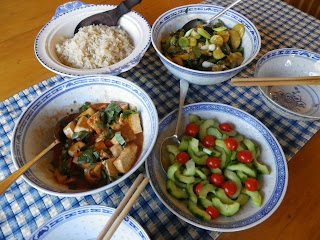

The A Little Bit of Everything dish here is the stirfry of cauli, broccoli, green beans, leek, zucchini and silverbeet, garnished with spring onion.
Too Much of a Good Thing is represented by the cucumber salad with cherry tomato garnish. (The dressing is a delicious mix of toasted sesame oil, white vinegar, sugar, soy sauce and Tabasco sauce, and the salad is chilled.)
With Frills On is the tofu dish, which is first fried with garlic, then briefly simmered in a sauce of coconut cream, tomato paste, chilli sauce and kaffir lime leaves. For serving the kaffir lime leaves are removed and lots of chopped basil (or coriander) is stirred through the dish.
Wednesday, January 16, 2013
Rock 'n' roses in the summer garden

While I was away in December the vege garden rioted!
But weeds make good mulch...


But when the digging is done the rocks make a good edging for the beds, and roses can take their place. (This one is Eglantyne, bred by David Austin and named after Eglantyne Jebb, who founded the charity Save the Children.)

Roses have edible hips which come later in the season, and sometimes I make rosehip jelly from the hips of the wild briar rose. Most of the time, however, I concentrate on growing and enjoying the premier fruits that are part of the rose family, such as apricots and strawberries.

Subscribe to:
Posts (Atom)